

Site Search
Search within product
第718号 2020(R02).02-03発行
Click here for PDF version
§日本土壌インベントリー(e−土壌図Ⅱ)が目指す土壌情報の発信
Research Center for Agricultural Environmental Change, National Institute of Agro-Environmental Sciences
Soil Resource Assessment Unit, Research Field of Environmental Information Infrastructure
高田 裕介
§沖縄県の主要3土壌における肥効調節型肥料を利用したオクラ春植え栽培の省力施肥について
Nago Branch, Agricultural Research Center, Agriculture, Forestry and Fisheries Department, Okinawa Prefecture
主任研究員 田中 洋貴
日本土壌インベントリー(e−土壌図Ⅱ)
が目指す土壌情報の発信
Research Center for Agricultural Environmental Change, National Institute of Agro-Environmental Sciences
Soil Resource Assessment Unit, Research Field of Environmental Information Infrastructure
高田 裕介
Introduction
Understanding the properties of soils, which are essential to the production of many crops, is very important for effective soil preparation and fertilizer management. The properties of soils, such as fertilizer retention, water retention, and drainage, are often affected by the base material and topography of the soil. For example, in plains where volcanic ash is deposited thickly, such as in the Kanto and Kyushu regions, black black soil is widely distributed.
This black soil has the property of strongly fixing phosphoric acid in the soil (phosphoric acid absorption coefficient of 1,500 or higher) and requires increased application of phosphoric acid for crop cultivation. In river flood plains, brown lowland soil, lowland paddy soil, gray lowland soil, and gley lowland soil are generally distributed from topographically higher to lower areas. When converting fields in areas where gray lowland soils (semi-wet fields) and gley lowland soils (wet fields) are distributed, it is especially important to implement drainage measures.
However, in brown lowland soils and lowland paddy soils, which are often found in drylands, drainage measures are less important, and conversely, in some cases, drought control measures are required. Even on the same topographic surface, the clay content and soil organic matter content tend to be higher in topographically depressed areas, and in such areas, the fertilizer and water holding capacity is also higher. Therefore, in order to promote appropriate soil preparation that takes into account the differences in soil properties, it is essential to use soil maps that show the distribution of each soil type at a glance.
2. development of soil inventory
Soil classification is the classification of soils based on their different origins and properties. In 2011, the National Institute of Agrobiological Sciences (NIAS) developed the first draft of a comprehensive soil classification system, which divides domestic soils into 10 major soil types and 381 more detailed soil types. Using this soil classification system, we have created two types of digital soil maps at different scales. One is a digital soil map of the entire country at a scale equivalent to 1:200,000, which covers the entire land area.
もう一つの土壌図は,農地のみを対象とした縮尺5万分の1相当のデジタル農耕地土壌図であり,農林水産省が1959〜1978年に実施した地力保全基本調査の成果物として作成された土壌図を基図としている。なお,土壌図の縮尺は土壌図作成のために行った土壌調査の空間的な密度を示し,縮尺5万分の1では,25haに1点の間隔で調査が行われたことを示している。
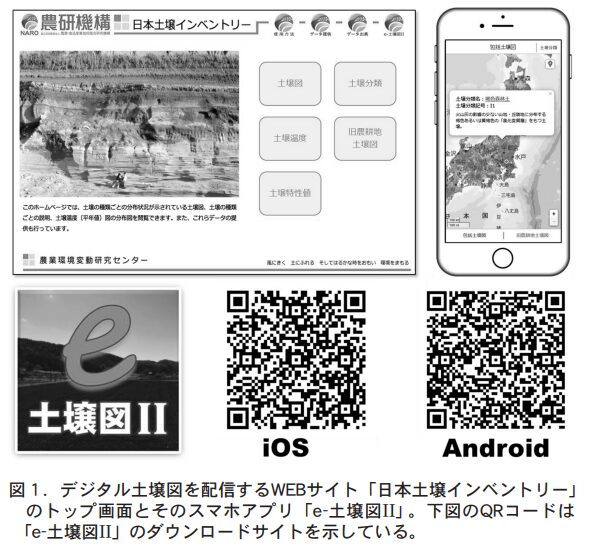
In April 2017, the National Institute of Agrobiological Sciences (NIAS) released the Japan Soil Inventory (https://soil-inventory.dc.affrc.go.jp/), which allows anyone to easily use digital soil maps and other soil information it has developed on the web. In April 2017, we also developed "e-Soil Map II," an application for smartphones (free of charge), so that digital soil maps can be used in the field as well (Figure 1). The word "inventory" in the above website name means "inventory of property," and since soil, which is the foundation of agricultural production, is an irreplaceable property, we used the word for managing that property in the website name.
3. soil information available in the Japan Soil Inventory
Soil information available in the Japan Soil Inventory is as follows
(1) Soil map covering the entire land area at a scale equivalent to 1:200,000 (also viewable on e-Soil Map II)
Soil map of agricultural land at a scale equivalent to 1:50,000 (also available on e-Soil Map II)
(iii) Soil temperature anomalies at 30-50 cm depth (1 km resolution)
4) Saturated hydraulic conductivity map and effective water capacity map showing soil permeability and water retention properties
⑤ 最大容水量(pF値=0) ,圃場容水量(pF値=1.5) ,初期しおれ点(pF値=2.7)および永久しおれ点(pF値=4.2)のそれぞれに相当する土壌水分含量マップ
6) Explanation of soil classification (also available on e-Soil Map II)
The Japan Soil Inventory provides digital soil maps as open data under the Creative Commons License (CCBY 4.0) with the copyright rule of Attribution 4.0 International Public, which allows modification and secondary use for commercial purposes under the condition that the original author's credit (National Agricultural Research Organization, Japan Soil Inventory) is indicated. The data is provided as open data that can be modified and secondary use for commercial purposes is permitted. The above digital soil map is also provided to the World Agricultural Data Relation Infrastructure (WAGRI), which is being developed in cooperation between the public and private sectors to promote the use of ICT in agriculture.
4. main functions of the Japan Soil Inventory and e-Soil Map II
(1) Soil map viewing function of the Japan Soil Inventory
The Soil Map Viewing Page of the Japan Soil Inventory is a webcast of digital soil maps projected on "GSI Tiles" provided by the Geospatial Information Authority of Japan (GSI). The map automatically switches to a soil map of agricultural lands when the map is enlarged (Fig. 2).
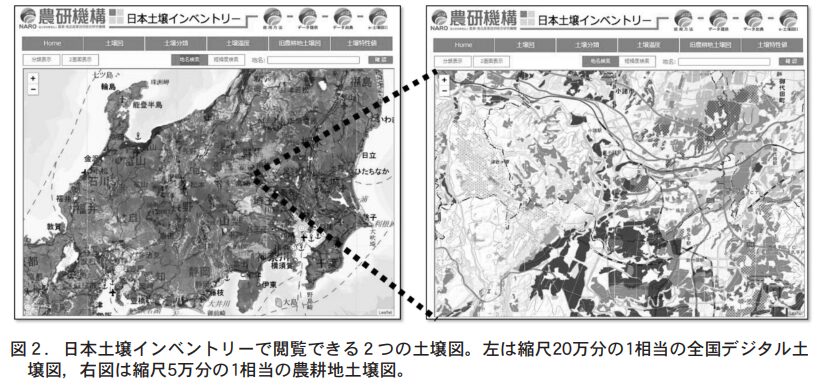
By clicking on a soil map, the name of the soil category distributed in that location is displayed, and the explanatory material containing the properties of the soil, a photograph of the soil cross section, and a distribution map can be viewed. Soil maps can also be searched by latitude, longitude, and address.
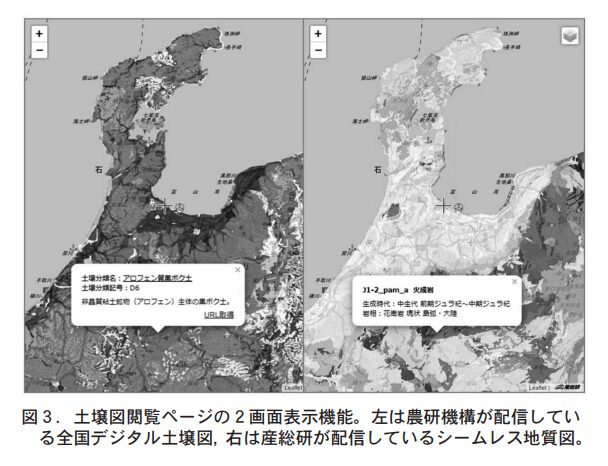
The soil map browsing page can be switched to a two-screen display, allowing users to view multiple aerial photographs taken at different times on the Geographical Survey Institute's Geographical Survey Map and the geological map published on the National Institute of Advanced Industrial Science and Technology's Seamless Geological Map V2 side by side with the soil map, enabling comparison of various information (Figure 3). The geological map can be viewed side by side with the soil map and compared with various information (Fig. 3).
The Soil Map Viewer page includes a classification display function that allows you to indicate the distribution of each soil taxon. As of November 2019, it is possible to refer to the Hokkaido Fertilizer Guide 2015, the Akita Rice Enhanced Taste Cultivation Manual (revised edition), and the Cultivation Standards for Common Crops (including Craft Crops) developed by Hokkaido, Akita, and Ibaraki Prefectures. The reference values for soil diagnosis and standard fertilizer application for each soil type are based on the "Hokkaido Fertilizer Guide 2015," "Akita Rice Taste Enhancement Cultivation Manual (Revised Edition)," and "Standard Crop Cultivation Standards (Including Craft Crops)" prepared by Akita and Ibaraki prefectures. In the future, we plan to link the standard fertilizer application rates prepared by each prefecture with the soil maps on a nationwide basis.
(2) Main functions of "e-Soil Map II
When the application is launched, a national map of loam equivalent to a scale of 1:200,000 is displayed, as shown in Figure 4 (left).
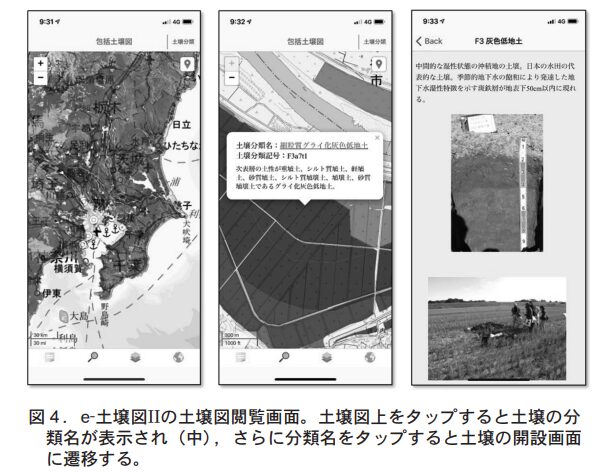
Pinching out" from the screen zooms in on the soil map, which automatically switches to the agricultural soil map (middle of Figure 4). Tap on the soil map to find out the name of the soil type distributed at that location (middle of Fig. 4), and tap on the name of the soil type to open the explanation page for that soil (right of Fig. 4). The application also allows users to easily search for a digital soil map using the user's location information from the mobile device's GPS.
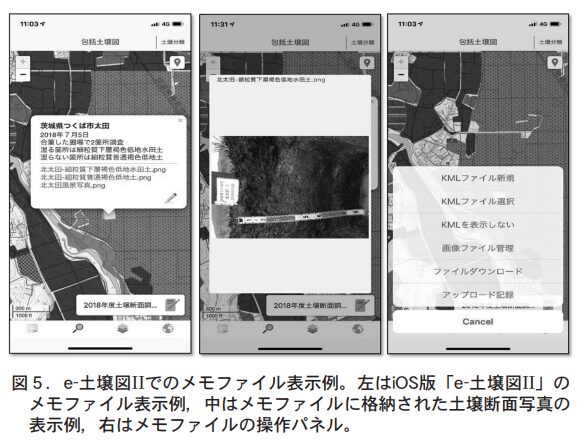
In e-Soil Map II, it is possible to display and edit field survey memos and photographs associated with soil maps, and to share and edit such memo information among users. Figure 5 shows an example of a memo file. In this memo file (left side of Fig. 5), the date and time of the soil cross-section survey, a photograph of the soil cross-section (middle of Fig. 5), the land management status of the field, the name of the soil classification, and the results of observations of the field and the soil cross-section are written in the memo field. This function allows users to place their own information on the soil map, making it possible to create a user-oriented soil map. This memo file can be shared among users via cloud storage provided by the National Institute of Agro-Environmental Sciences.
5. use of digital soil maps in agricultural production
(1) Refer to the Basic Guidelines for Geo-Enhancement
In 2008, the Ministry of Agriculture, Forestry and Fisheries (MAFF) revised the Basic Guidelines for Soil fertility Enhancement, which provide basic soil management methods and promotion of appropriate soil management for soil development, basic improvement targets and basic improvement measures for soil properties, and other important matters related to soil fertility enhancement. Among them, the "basic improvement target of soil properties" defines target values for improvement of soil properties (pH, effective phosphate, etc.) for each major soil type. Therefore, it is possible to refer to the basic improvement target values of soil properties indicated in the basic guideline for soil fertility improvement by using the Japanese Soil Inventory and e-Soil Map II to check the soil type.
In addition, the Basic Guidelines for Soil fertility Enhancement promotes soil fertility through the conversion and utilization of organic resources such as livestock manure as "Important Matters for Soil fertility Enhancement. Therefore, the guideline provides standard values for the application of compost for each soil type (black-box soil or not), normal soil temperature (30 to 50 cm below the soil surface), and cultivated crop (rice, field crops, vegetables, and fruit trees). Using the two-screen display function of the Japanese Soil Inventory, it is possible to simultaneously examine soil type and soil temperature at any location, and to refer to the standard values for fertilizer application in soil preparation.
(2) Confirmation of soil characteristics of candidate farmland for lease
One of the growing applications of digital soil maps is to confirm the soil properties of candidate farmland for lease. The soil properties that are of concern when leasing farmland can be determined by looking at the soil map, such as whether the soil distributed on the candidate farmland has the same properties as the farmland that has been managed so far, whether the soil is suitable for the crop to be planted, and whether the farmland has good drainage and water retention properties.
例えば,借上げ候補農地が現在管理している農地と同じ土壌の種類が分布している場合,同じような栽培方法が適用できる可能性は高くなる。例えば,土壌の名前についている「細粒質/中粗粒質」は土壌中の粘土の量を表わし,細粒質では粘土量が多いため一般的に肥持ちが良く,粗粒質では砂が多く肥持ちが悪い。また,グライ低地土,停滞水グライ土,グライ黒ボク土など,「グライ」と名前がつく土壌の種類は,酸素が欠乏した土層を表層下50cm以内にもつため,畑作物などを栽培するためには排水対策が重要となる。さらに,泥炭土や“泥炭質”グライ土などと土壌の種類名に泥炭とあるものは土壌断面内に泥炭(植物遺体)でできた土層があることを示し,一般的に水はけが悪く,地耐力に乏しく排水などにより地盤沈下が生じやすいなどの性質をもつ。
In addition, soil with the name "black box soil" in the soil type name has a property that makes it difficult for phosphate fertilizers to be effective, so it is necessary to check the amount of phosphate that can be absorbed by crops through soil diagnosis. Thus, knowing the name of the soil type is very important information for the "soil preparation" of the leased farmland.
6. dissemination of soil information aimed at by the Japan Soil Inventory (e-Soil Map II)
Finally, the following are the three main goals of the Japan Soil Inventory for the future dissemination of soil information.
(i) 信頼性と持続性The following is a brief summary of the soil inventory and its information distribution.
(2) 即時性The immediacy of the information, such as soil temperature and soil moisture, will be enhanced by transmitting predictions of daily changes.
(iii) 多様性We will continue to develop applications to meet diverse soil information needs and promote the diversification of soil information. Specifically, we are developing: i) a function to display daily changes in estimated values of soil temperature and moisture (30-year average); ii) a function to visualize the accumulation (decrease) of soil organic matter based on the amount of organic matter input such as compost; and iii) a function to visualize the fertilizer efficacy of compost and the possible amount of chemical fertilizer reduction.
Fertilizer with regulated fertilizer efficacy in three major soils in Okinawa Prefecture.
Labor-saving fertilizer application for spring planting of okra using
Nago Branch, Agricultural Research Center, Agriculture, Forestry and Fisheries Department, Okinawa Prefecture
主任研究員 田中 洋貴
Introduction
Okinawa Prefecture's okra shipments are the third largest in Japan, and it is grown throughout the prefecture as a specialty vegetable. Okra cultivation requires a large number of fertilizer applications, and there are calls for the development of fertilizer with regulated fertilizer efficacy and the establishment of fertilizer application standards in order to save labor at production sites. In addition, okra cultivation in Okinawa Prefecture is carried out on three soils with very different characteristics, namely Jargal, Shimajiri Merge, and Kunigami Merge, and the appropriate amount of fertilizer for each soil may differ.
In order to develop and promote the use of fertilizer with regulated fertilizer in spring planting of okra, we conducted a two-year trial of fertilizer with regulated fertilizer on three soils to determine the appropriate amount of fertilizer to be applied to enable labor-saving fertilization.
2. Outline of the test
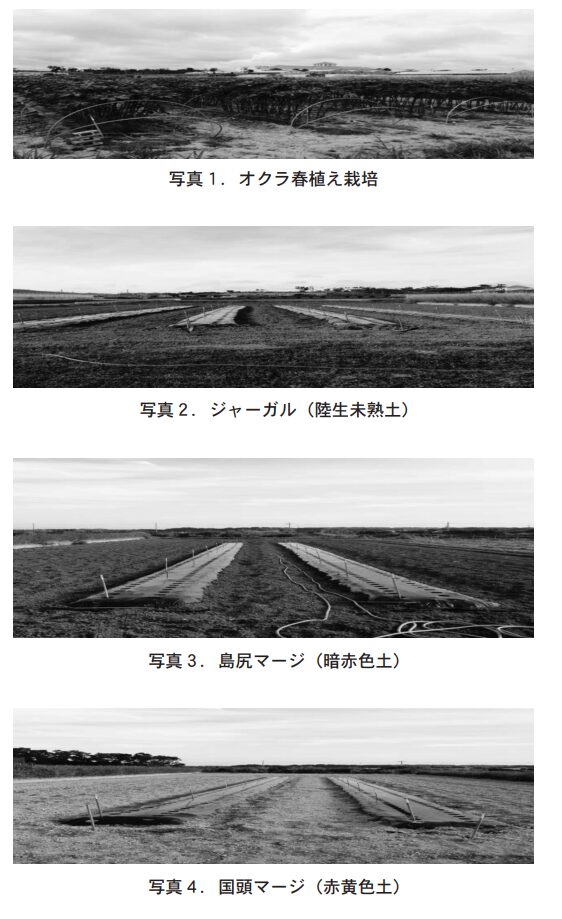
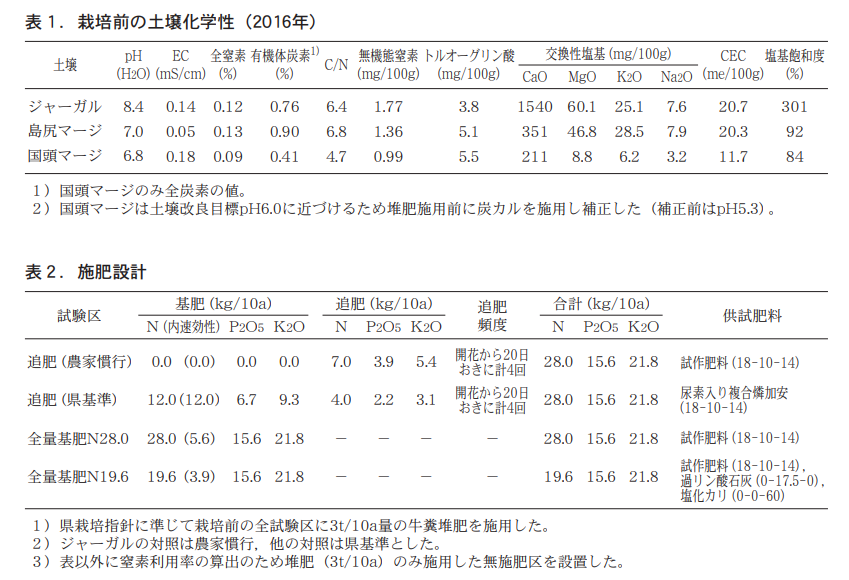
栽培体系は春植え(3月下旬播種,5月下旬開花,8月下旬収穫終了)とし,ジャーガル(陸生未熟土) ,島尻マージ(暗赤色土) ,国頭マージ(赤黄色土)の3圃場で行った。品種は「ブルースカイ」を供試し,栽植様式は1穴3本仕立ての2条植え,株間25cm,条間40cm,畝幅は150cmとし黒マルチを用いた。供試土壌の化学性は表1(2015年はデータ省略)のとおりである。
施肥設計は,表2のように,試作の肥効調節型肥料(18−10−14,N緩効率80%,LPS80:LPS140=35:65)を用いた全量基肥体系と慣行の「尿素入り複合燐加安804号(18−10−14)」を用いた追肥体系を設け,生育および収量,みかけの窒素収支等の比較を行った。
In this study, we examined whether or not the total basal application of the prototype fertilizer was excessive or insufficient in terms of fast-acting nitrogen for initial yield and slow-acting nitrogen for mid- to late-season yield in relation to the conventional fertilizer system in each soil, and clarified the appropriate amount of the prototype fertilizer to be applied.
Results and Discussion
(1) Jargal.
Jargal has the most fertile soil in the prefecture, located in the southern part of the main island, and is a major producer of many horticultural products, including okra. In the production site, many growers are concerned about overgrowth of okra, which may lead to poor fruit set, so they do not apply base fertilizer, but use supplementary fertilizer instead, which differs from the prefectural fertilization standard. This prototype fertilizer was designed to be used mainly in jargal cultivation, with a low amount of fast-acting nitrogen as a base fertilizer (about half of the prefectural fertilizer standard).
The two levels of nitrogen application with total basal fertilizer did not show significant overgrowth in the early stage and no reduction in initial yield (total marketable fruit yield in May and June) due to flower drop, suggesting that the amount of fast-acting nitrogen as basal fertilizer (3.9-5.6 kg/10a, calculated from 80% with nitrogen slow efficiency) is appropriate (Table 3). Table 3). Next, regarding the nitrogen leaching of the two LP coats as substitutes for fertilizer, LPS80 became higher around late May, which was the flowering period, and LPS140 became higher around mid-June, after flowering (Figure 1).
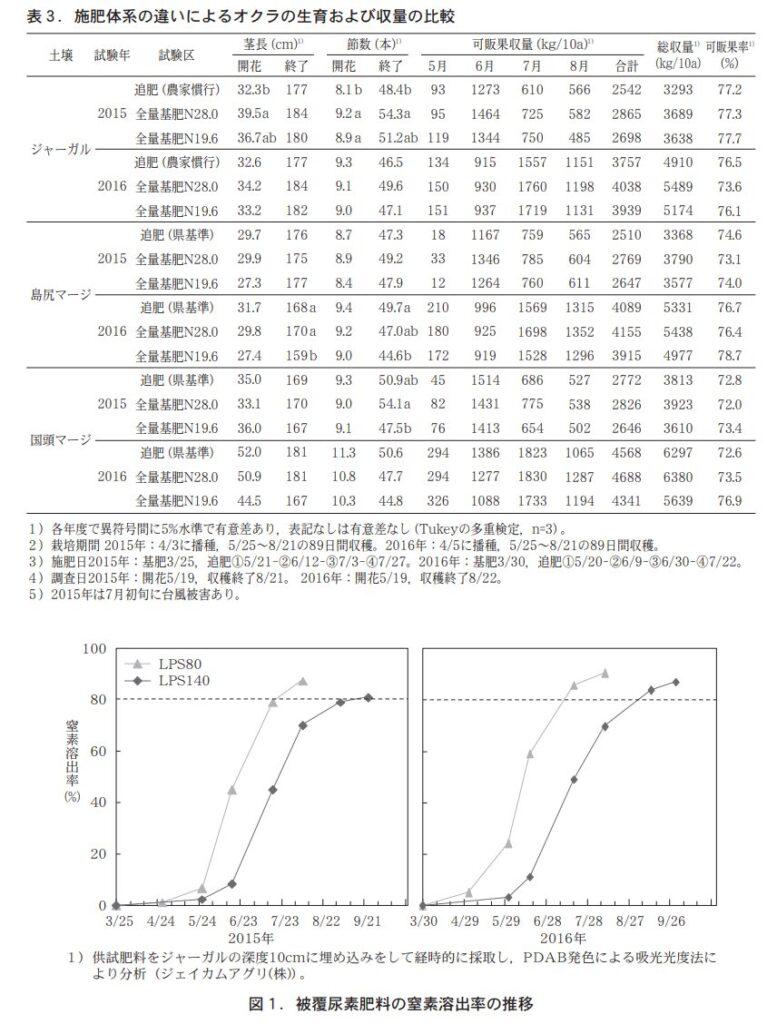
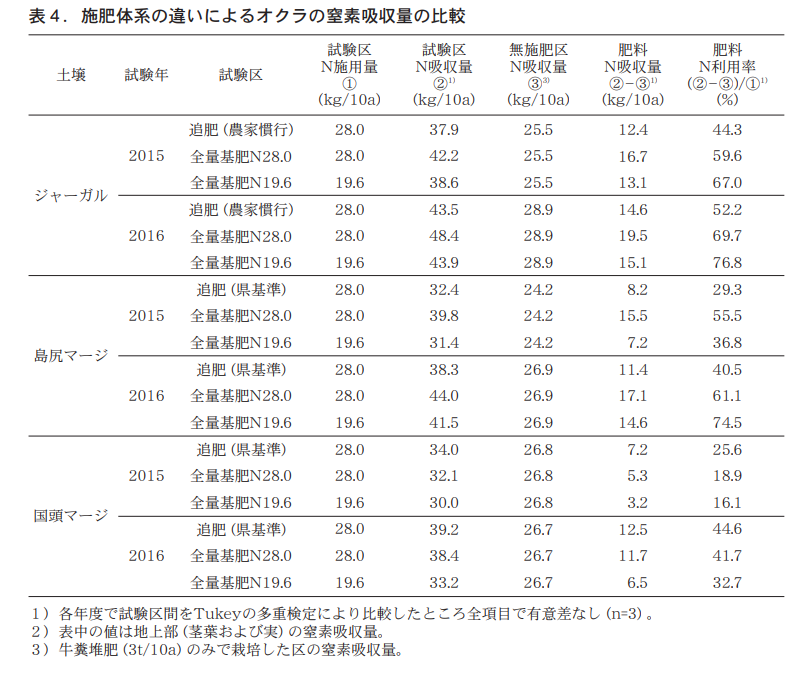
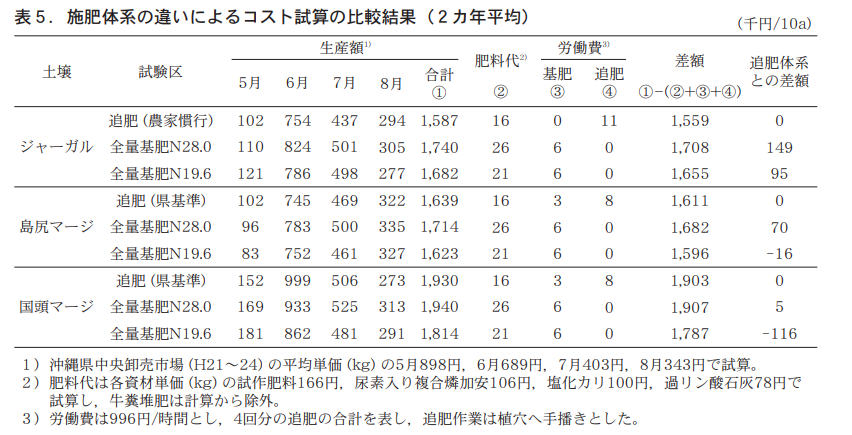
The nitrogen leaching rate of 80%, which is an indication of fertilizer efficacy, was in mid-July with LPS80 and in early September with LPS140, thus maintaining nitrogen supply during the harvest period in spring-planting cultivation (Figure 1). Next, nitrogen uptake was highest when 28.0 kg of nitrogen/10 a of total basal fertilizer was applied, and was almost equal to that of the additional fertilizer system when 19.6 kg of nitrogen/10 a was applied (Table 4). The same was true for the total saleable fruit yield (Table 3). In the final cost estimation results, the difference between the two nitrogen application levels of total basal fertilizer and the fertilizer application system was positively evaluated (Table 5).
3) Kunigami Merge
The Kunigashira merge is the least productive soil in the prefecture, located in the northern part of the main island, and as with the Shimajiri merge, most okra production sites apply basal fertilizer according to the prefectural fertilizer standard. Both the two levels of nitrogen application of total base fertilizer tended to decrease initial growth and yield (total yield in May and June) compared to the fertilizer system (Table 3). This suggests that 3.9 to 5.6 kg/10a of fast-acting nitrogen in the prototype fertilizer may be insufficient. However, the application of 28.0 kg nitrogen/10 a of total basal fertilizer tended to increase mid- and late-season yields (June-July) compared to the fertilizer system, and total producible fruit yield was similar or higher, although nitrogen absorption was slightly lower (Tables 3 and 4).
一方,全量基肥の窒素19.6kg/10a施用は,追肥体系に対して,窒素吸収量および総可販果収量が減少した(表3,4) 。最終的なコスト試算結果では,追肥体系と比較し,全量基肥の窒素28.0kg/10a施用でプラス評価であったが,窒素19.6kg/10a施用はマイナス評価であった(表5) 。窒素19.6kg/10a施用は,追肥体系と比較し,2カ年平均の総可販果収量でそれぞれ3493kg/10a,3670kg/10aと5%程度の減収であったが,追肥体系との差額は11.6万円と大幅な差がついた。これは,オクラの単価(円/kg)は,5月898円,6月689円,7月403円,8月343円となっており(沖縄県中央卸売市場のH21〜H24月別平均) ,初期収量の差が大きく反映された結果であった(表3,5) 。
Summary
These results suggest that the trial fertilizer can be applied at the standard nitrogen level (28.0 Nkg/10a) and 70% (19.6 Nkg/10a) in Jargal's spring-planted okra cultivation to save labor while maintaining yield. In the Shimajiri and Kunigami merges, labor saving in fertilizer application was possible by applying the standard amount of nitrogen.
The prototype fertilizer was designed with a low base fertilizer because its main purpose was to be used in Jargal, but it became clear that it could be used in soils with different properties by adjusting the amount of nitrogen applied. However, at the Kunigami Margin, yields were lower in May and June, when unit prices are high, at the standard and 70% application rates of the prototype fertilizer, so there is room to reconsider the use of fast-acting nitrogen in the formulation. In the future, we would like to conduct field trials of the prototype fertilizer and continue to improve it with the aim of promoting its widespread use.